
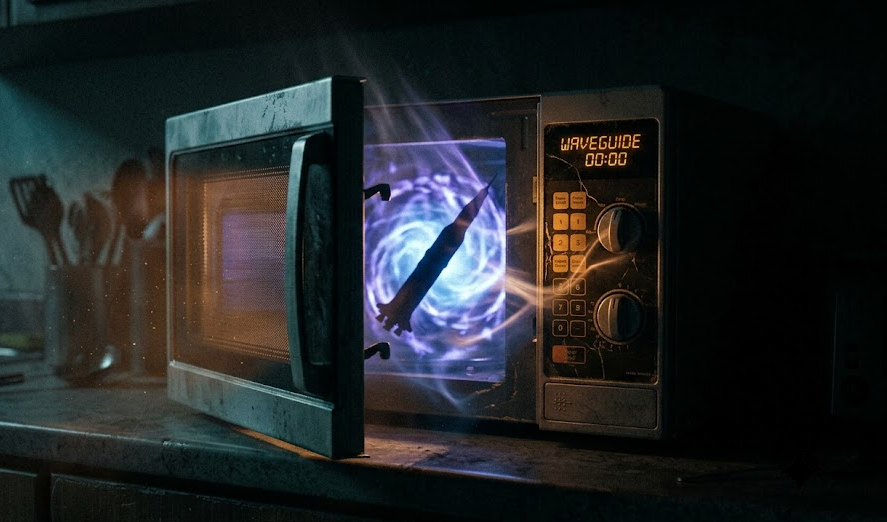
Here’s something most people never think about: the microwave oven heating up your leftovers and a missile defense radar system run on the exact same underlying physics. It sounds like a stretch, but it isn’t. Both technologies trace back to the same wartime invention — and the story of how that happened is one of the more unexpected chapters in 20th-century engineering.
It Started With Two Physicists in Birmingham
In 1940, Britain was deep into the Battle of Britain, and German U-boats were devastating Allied shipping in the Atlantic. At the University of Birmingham, physicists John Randall and Harry Boot were working on a specific, urgent problem: how to build a radar system small enough to fit in an aircraft, but powerful enough to actually matter.
Their answer was the cavity magnetron. Other countries — France, Russia, Japan — had experimented with magnetrons before, but none had solved the power problem. Randall and Boot did. The device could generate microwave energy at a scale nobody else had achieved, and it had the potential to change the direction of the war.
The challenge was that Britain, stretched thin by the war effort, didn’t have the industrial capacity to manufacture it at scale.
A High-Stakes Exchange
In September 1940, a British delegation led by Sir Henry Tizard traveled to the United States carrying a working cavity magnetron — one of the war’s most closely guarded secrets. The mission’s purpose was direct: trade Britain’s most advanced technology for American manufacturing capability.
When American scientists saw it demonstrated, the reaction was disbelief. Their own radar research had been producing only a fraction of the power the British device generated — by some estimates, a thousand times less. One historian later described it as “the most valuable cargo ever brought to our shores.”
That exchange led directly to the founding of the Radiation Laboratory at MIT before the end of 1940 — a research effort deliberately given an unremarkable name as wartime cover. Magnetron production scaled rapidly, climbing from a handful of units to thousands per day.
What’s often left out of this story is the second half of the engineering problem: a magnetron generates microwave energy, but that energy needs a precise, low-loss path to travel. That’s the role of the waveguide — a hollow metal structure that channels microwave energy in a controlled direction, the way a hallway directs movement rather than letting it scatter freely. It’s a simple analogy, but it turns out to be a remarkably literal one.
An Accidental Discovery
By 1945, the war was winding down. Percy Spencer, an engineer at Raytheon who had risen through the company largely through self-taught expertise, was standing near an active magnetron when he noticed something odd: a candy bar in his pocket had melted.
Most people would have shrugged it off. Spencer was curious enough to investigate further. He began testing the effect deliberately — placing popcorn kernels near the magnetron and watching them pop, then trying an egg, which famously ended in a small explosion when a colleague leaned in too closely.
Spencer built a metal enclosure, positioned the magnetron to direct energy inside, and arrived at the basic design for the modern microwave oven. Raytheon filed a patent in 1945, and the first commercial unit — called the Radarange, in a nod to its origins — went on sale in 1947. Early models stood nearly six feet tall, weighed several hundred pounds, and cost thousands of dollars, limiting them to commercial kitchens and ships for years before they became practical for home use.
The Same Physics, Very Different Stakes
The connection between a kitchen appliance and a missile defense system isn’t a loose metaphor — it’s a direct technical lineage. The waveguide physics that guides energy into a microwave oven is the same physics behind air traffic control radar, weather radar, satellite communications, and modern military radar and missile defense systems.
Next time a microwave oven runs its cycle, it’s worth remembering that the same core technology, refined and scaled, is quietly at work in the radar and defense systems protecting aircraft, ships, and satellites today.
Each application places different demands on the technology — different frequencies, different power levels, different tolerances for size and durability — but the underlying principle has remained consistent for more than 80 years: direct electromagnetic energy precisely, with minimal loss, regardless of what’s on the receiving end.
It’s a useful reminder that some of the most consequential engineering breakthroughs don’t begin with a clear destination in mind. Spencer wasn’t trying to invent a kitchen appliance — he simply noticed something unusual and decided to follow it.